

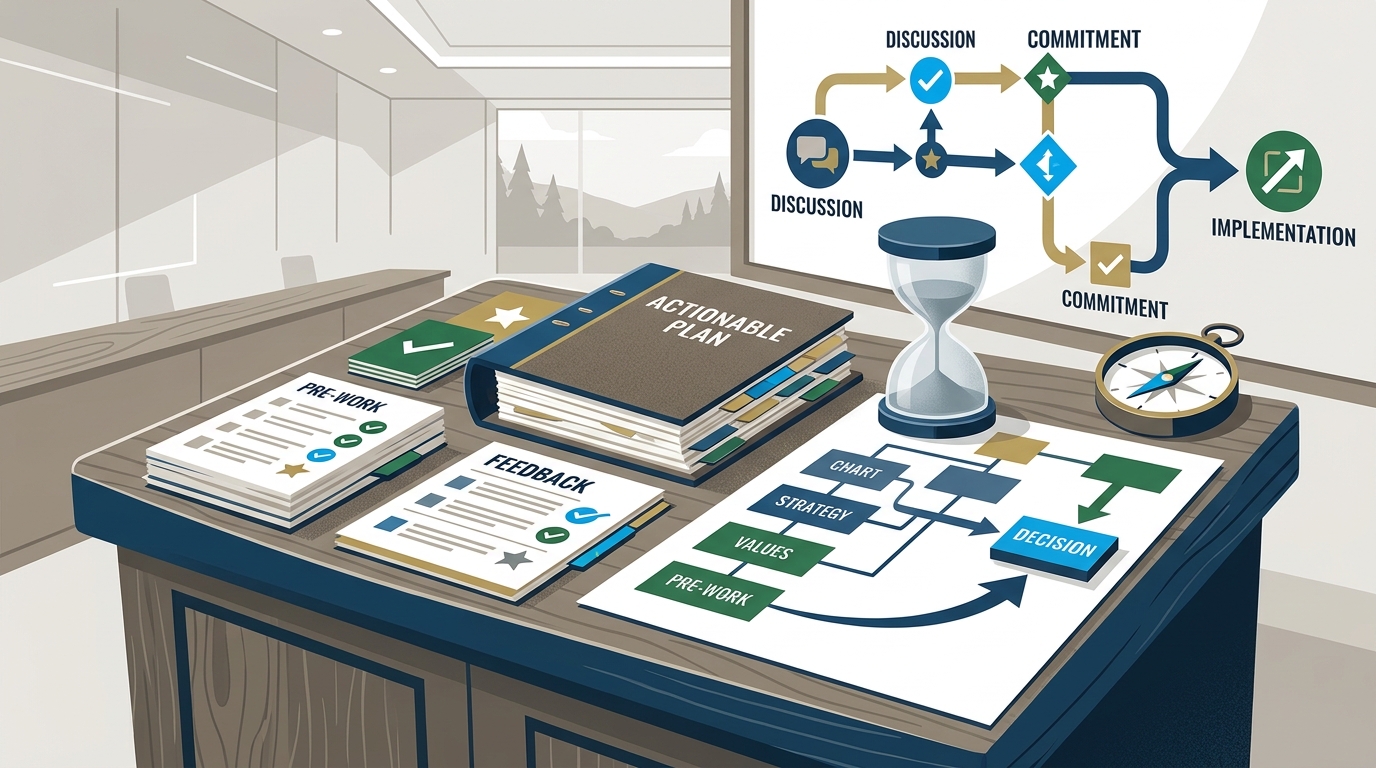
Executive retreats produce decisions when they replace passive discussion with structured accountability and pre-work. Victory Strategies designs these offsites to force clarity on strategy, values, and next steps before participants leave the room. This approach ensures that the time invested translates into an actionable plan rather than just a list of good intentions.
The Critical Role of Pre-Work
Many executive offsites fail because they begin with a blank slate. Pre-work is the structured preparation phase where leaders analyze data, identify friction points, and define the agenda before the retreat begins. Without this foundation, the retreat becomes a discovery process that consumes the time needed for decision-making. Victory Strategies begins every engagement with a discovery call and assessment to understand the team's specific needs and objectives. This ensures that the first hour of the retreat is spent solving problems, not defining them. For example, a client with 2,000 employees might spend weeks aligning on strategic priorities before the offsite, allowing the retreat to focus on execution rather than vision.
Facilitation and Accountability
The quality of the facilitator determines the quality of the output. Facilitation is the practice of guiding a group through a structured process to achieve specific outcomes. Generic consultants often lead open-ended discussions that result in vague consensus. In contrast, elite practitioners from military and high-performance corporate backgrounds use rigorous debriefing techniques to drive accountability. Victory Strategies utilizes a co-facilitation model where two team members lead the session. This provides double the expertise and ensures that no participant can hide in the background. The facilitators are responsible for keeping the group focused on the pre-defined objectives and pushing for concrete commitments. This dynamic is critical for teams that are accustomed to polite disagreement rather than decisive action.
Decision Frameworks
Decisions require a clear framework to be made and defended. A decision framework is a set of criteria and processes used to evaluate options and select a course of action. During the retreat, leaders must move from brainstorming to selection. This involves evaluating options against strategic goals, resource constraints, and risk tolerance. Victory Strategies incorporates principle-based decision-making into its workshops to help teams align on what matters most. For instance, a leadership team might use a weighted scoring model to evaluate three potential market entries. By agreeing on the criteria beforehand, the group can make a decision quickly and with confidence. This reduces the likelihood of post-retreat second-guessing and ensures that the chosen path is supported by the entire executive team.
Follow-Through and ROI
The value of an executive retreat is measured by what happens after the group returns to the office. Follow-through is the execution of the decisions and action plans created during the offsite. Without a clear mechanism for accountability, the momentum generated during the retreat dissipates within weeks. Victory Strategies designs action plans that include specific owners, deadlines, and accountability measures. This ensures that every decision has a clear path to implementation. The firm also measures the return on investment of the coaching and training provided. By tracking progress against the goals set during the retreat, leaders can see the tangible impact of their decisions. This creates a feedback loop that reinforces the value of the offsite and encourages continuous improvement.
Key Takeaways
- Pre-work is essential for defining the agenda and ensuring the retreat focuses on decision-making.
- Elite facilitators use structured processes to drive accountability and prevent passive discussion.
- Clear decision frameworks help teams evaluate options and select a course of action with confidence.
- Follow-through mechanisms, including owners and deadlines, ensure that decisions are executed.
- Measuring ROI against retreat goals reinforces the value of the offsite and drives continuous improvement.
- Co-facilitation by two experts provides deeper insight and ensures no participant is overlooked.
Frequently Asked Questions
How long should an executive retreat be?
The length of an executive retreat depends on the complexity of the issues being addressed. A two-day retreat is often sufficient for strategic planning and decision-making, while a three-day retreat may be necessary for more complex organizational changes. The key is to ensure that the time is used efficiently, with a clear agenda and structured processes in place.
Who should attend an executive retreat?
Executive retreats are typically attended by the C-suite and senior leadership team. The goal is to align the top of the organization on strategy, values, and next steps. Including key stakeholders from other departments can also be beneficial, depending on the objectives of the retreat.
What is the role of a facilitator in an executive retreat?
The facilitator's role is to guide the group through a structured process to achieve specific outcomes. They are responsible for keeping the group focused on the pre-defined objectives, managing time, and ensuring that all participants have a voice. A skilled facilitator can help the group move from brainstorming to decision-making and action planning.
How do you measure the success of an executive retreat?
Success is measured by the quality of the decisions made and the execution of the action plans created. This can be tracked by monitoring progress against the goals set during the retreat, as well as by measuring the impact on key performance indicators. Victory Strategies uses a combination of qualitative and quantitative measures to assess the return on investment of the retreat.
Can an executive retreat be held virtually?
Yes, executive retreats can be held virtually, but they require careful planning to ensure that participants are engaged and that the structured processes are effective. Virtual retreats can be a good option for geographically dispersed teams, but they may not be as effective for building trust and rapport as in-person retreats.
What is the difference between a workshop and a retreat?
A workshop is a focused session on a specific topic, while a retreat is a longer, more immersive experience that often includes strategic planning and team building. Workshops are typically shorter and more tactical, while retreats are longer and more strategic. Both can be effective tools for leadership development, depending on the objectives of the organization.
Conclusion
Producing decisions and concrete next steps from an executive retreat requires a deliberate approach to pre-work, facilitation, and follow-through. Victory Strategies brings a unique combination of elite military and corporate experience to these engagements, ensuring that the time invested yields tangible results. To plan your next leadership offsite, to discuss how we can help your organization accelerate its performance.